
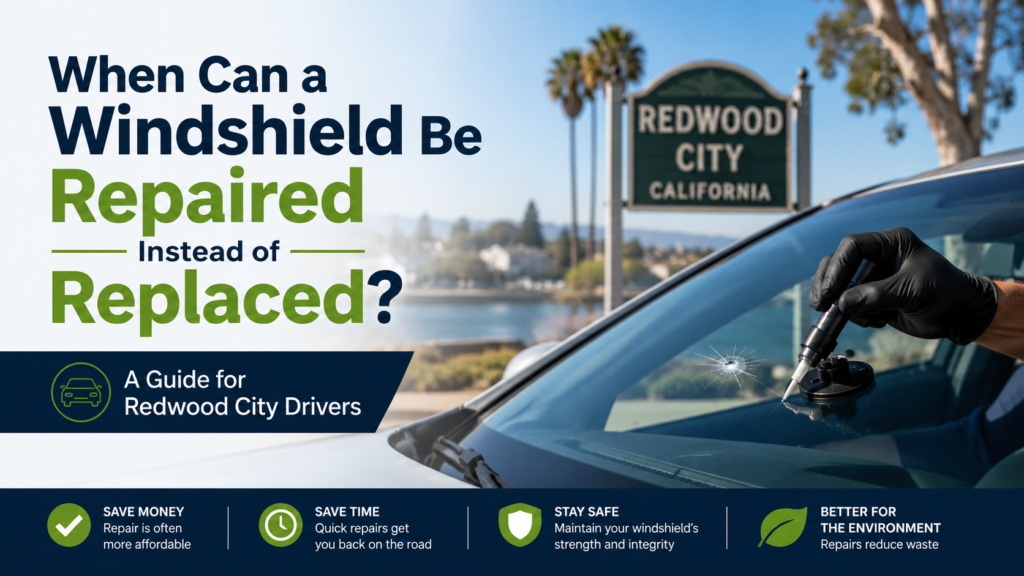
Redwood City sits along the San Francisco Bay in San Mateo County, a city experiencing rapid growth as Silicon Valley’s tech economy has expanded up the Peninsula. With major corporate campuses, the active Caltrain corridor, and dense commuter traffic on US-101 and the Dumbarton Bridge approach, Redwood City drivers log significant road miles each week. That road exposure means windshield chips and cracks are a regular occurrence debris from construction activity near downtown’s development boom, gravel from landscaping trucks, or rock fragments from vehicles sharing the 101 freeway. The question that follows is always the same: can this be repaired, or does it need to be replaced? The answer depends on specific, well-established criteria that Redwood City drivers should understand before making decisions about their vehicle’s glass.
What Makes a Windshield Repairable
Auto glass repair is not guesswork it is a process governed by clear technical parameters. The Repair of Laminated Auto Glass Standard (ROLAGS), developed by the National Windshield Repair Redwood city Association, establishes the industry guidelines for what damage is safely repairable. The key criteria are:
- Chip or bullseye diameter of one inch or less: Damage confined to a small area gives the resin enough surrounding undamaged glass to bond to and produce a structurally sound repair.
- Crack length of three inches or less: Short cracks, particularly those that have not spread far from the impact point, can often be successfully filled with repair resin.
- Damage confined to the outer glass layer only: Modern windshields are laminated two glass layers with a plastic interlayer. Repairable damage affects only the outer layer. Damage penetrating the plastic interlayer requires replacement.
- Damage not within two inches of the windshield’s edge: Edge damage compromises the bonding of the windshield to the vehicle frame, which is a structural and safety concern that repair cannot adequately address.
- Damage not directly in the driver’s primary sight line: Repair resin fills the void in the glass but leaves a slight optical distortion. This distortion should not be in the center of the driver’s forward view, where it could interfere with visibility.
- Damage that is clean and dry: Chips and cracks that have been contaminated with road dirt, water, or debris are less successfully repaired because the contamination prevents the resin from bonding cleanly. Fresh damage repairs best.
What Disqualifies Damage from Repair
Just as important as understanding what can be repaired is understanding what cannot. The following conditions require replacement rather than repair:
- Long cracks typically more than three inches particularly cracks that run across a significant portion of the windshield.
- Any crack that extends from the edge of the windshield inward, even a short one, because edge cracks compromise the adhesive seal.
- Multiple chips or cracks distributed across the windshield surface, indicating overall glass weakness.
- Damage that has spread significantly since the initial impact spread damage is harder to repair cleanly and indicates the glass is already compromised.
- Damage on the inner surface of the windshield (which can occur from inside-vehicle impacts). Inner surface damage cannot be reached by standard repair equipment.
- Pitting tiny surface abrasions from sand and debris striking the glass repeatedly over time. Pitting causes haze and reduces optical clarity but is a gradual process rather than a single impact. Extensive pitting typically warrants replacement.
The Importance of Timing in Redwood City’s Climate
Redwood City experiences the Bay Area’s characteristic moisture morning fog rolling in from the Bay, the occasional persistent coastal rain during winter months, and humidity that is significantly higher than inland California. This climate matters for windshield repair for a specific reason: chips and cracks that remain open and exposed to moisture become much more difficult to repair successfully.
When moisture enters a chip or crack through rain, condensation, or car washing it works its way into the void in the glass. Repair resin does not bond well to wet or contaminated glass. The technician can dry the area with heat lamps or a heat gun, but chips that have been repeatedly wetted and dried have often absorbed moisture deep into the void and the surrounding glass. The resulting repair may be stronger than no repair, but the optical clarity is reduced compared to repair performed on fresh, dry damage.
The practical takeaway for Redwood City drivers: when a chip occurs, do not wash the car before getting it repaired, park the vehicle in a covered or sheltered location if possible, and seek repair within a few days while the damage is still clean and dry.
Driving Safely with a Damaged Windshield
California Vehicle Code Section 26710 addresses windshield condition, prohibiting operation of a vehicle with a windshield that is so damaged that it impairs the driver’s vision. A small chip away from the driver’s line of sight does not typically constitute a violation, but a large crack across the windshield particularly one in the driver’s field of view can result in a fix-it ticket during a traffic stop.
Beyond legal compliance, the safety argument for prompt attention to windshield damage is straightforward. The windshield is one of the most important safety components in a modern vehicle. It provides approximately 30 percent of the cabin’s structural rigidity, supports the roof in rollover accidents, provides the backstop that allows the passenger-side airbag to deploy correctly, and maintains the occupants inside the vehicle during severe impacts. A compromised windshield whether from a large crack or from improper or delayed repair may not fulfill these functions.
The Repair Process: What to Expect
For Redwood City drivers who have not had a windshield repair before, the process is less involved than many expect. A mobile technician which is the most convenient option for Bay Area drivers comes to the vehicle at the driver’s home, workplace, or wherever the car is parked. The repair takes 30 to 60 minutes and follows these steps:
- Inspection: The technician examines the damage to confirm it meets repair criteria.
- Cleaning: Loose glass fragments are carefully removed from the damage point and the surrounding area is cleaned.
- Bridge placement: A small suction-cup bridge device is centered over the damage, creating a sealed chamber.
- Resin injection: Repair resin is injected into the void under controlled pressure, filling all cracks and voids within the damaged area.
- Curing: Ultraviolet light cures the resin, hardening it to bonding strength comparable to the surrounding glass.
- Polishing: The surface is polished to smooth any excess resin.
The vehicle can be driven immediately after repair. The repair will not be optically perfect a faint trace of the original damage may be visible at close inspection or in specific lighting but it will be structurally sound and functionally invisible during normal driving.
Insurance and Windshield Repair in California
Redwood City drivers with comprehensive auto insurance should take full advantage of their coverage for windshield damage. California law requires insurers offering comprehensive coverage to also offer a zero-deductible option for windshield repair. Under many comprehensive policies, a chip repair may be fully covered at no out-of-pocket cost to the insured, because it is less expensive for the insurer to pay for a repair now than a replacement claim later if the chip spreads to a crack.
Even when a zero-deductible policy is not in place, the cost of a chip repair is low enough that many drivers prefer to pay out of pocket rather than involve their insurer. The decision depends on the individual deductible amount. Replacement, on the other hand, is typically more expensive than most deductibles, making insurance involvement more commonly worthwhile.
Conclusion
For Redwood City drivers, the key to navigating windshield damage is understanding the criteria that determine whether repair or replacement is appropriate size, location, depth, and the age of the damage and acting promptly when damage occurs. Fresh damage is almost always more repairable than old damage. Bay Area moisture makes timely repair particularly important. And California’s insurance framework often makes windshield repair a zero-cost option for drivers with comprehensive coverage. The combination of prompt action and informed decision-making keeps Redwood City drivers safely on the road while protecting them from unnecessary expense.